
 en
en Delightful curiosities and rarities
6.10.2025
Now that I have gone through about 700 performance photographs in the Theatre Museum’s digitization project, it has become clear what a typical theatre performance photo looks like. Most often, theatre photography follows the style of its time, both in the aesthetics of theatre and photography. The results are fairly expected utility images – though there are differences between photographers. During the project, I have also come across curiosities. Attention is drawn to images that contain something unusual, unexpected, and rare.
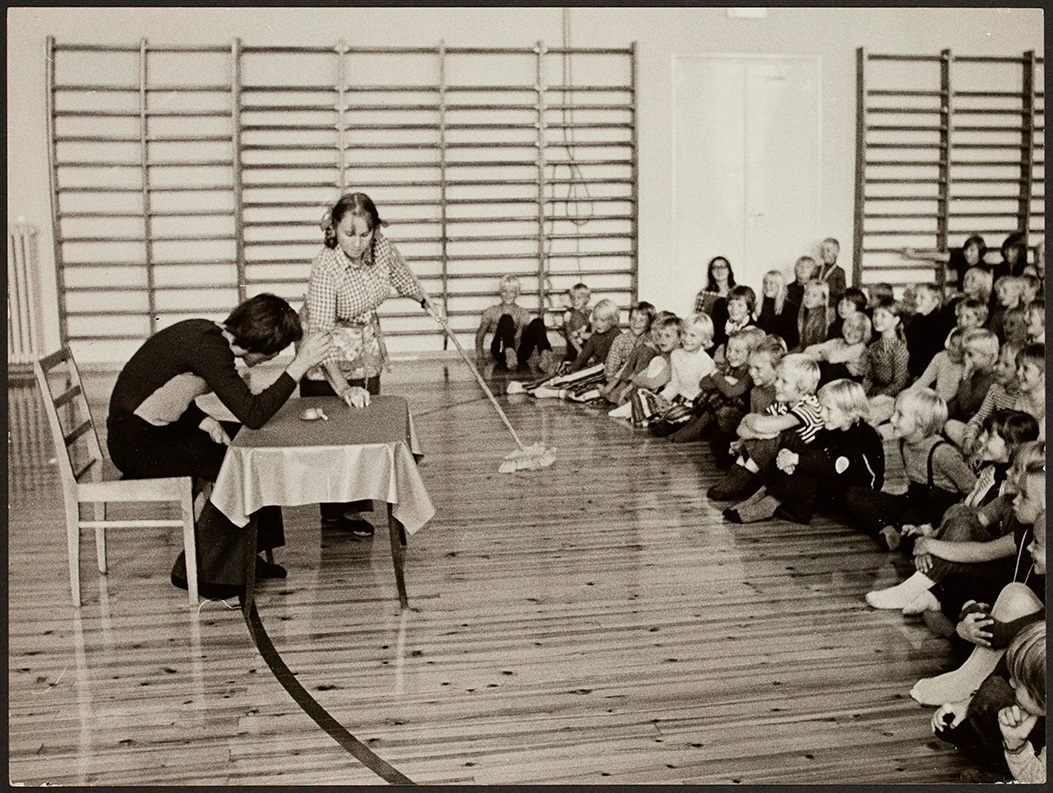
As the name suggests, the performance photo collection usually consists of tightly framed photographs of theatre performances on stage. As a researcher, I am delighted by rehearsal photos or images that also include the audience or musicians. One example is a photo taken in Savonlinna in 1912 during the dress rehearsal of the opera Aino, which shows not only the performers but also the orchestra, wall structures, auditorium chairs, and a few backs. A more recent case is Alldeles vanliga Ville (1972) by Skolteatern, where we see children sitting on the gym floor and reacting to the performance.
In the performance of an unknown theatre, Le Chalet (Alppimaja), a violinist and pianist are partially visible, along with the candles used for lighting. A large group of performers appears in a scene on a very small stage. The photo clearly shows the uniforms used as costumes and props such as cups. The piece was a French comic opera performed around the turn of the 20th century.

A true rarity appeared early in the project when I catalogued performance photos of Ad astra (1925) by Kotkan Näyttämö. The play, written by Larin-Kyösti, is a symbolist drama, and the unnamed photographer experimented with color in the photos. Interestingly, Ad astra premiered in Viipuri in 1924, but these experimental images were taken in Kotka the following year. Black-and-white photos and postcards were already being colored in the 19th century, but these differ from that tradition. The photographer clearly had an artistic intention to reflect the dreamlike world of the play using gradient coloring techniques. Alongside the series tinted in blue, red, yellow, and green, conventional black-and-white performance and role photos were also taken.

A long temporal distance from the era’s favorite works can bring a certain unintended humor to the images, and the photographer may not always have had the best day. For example, Aksel ja Valpur (also known as Aksel ja Walpuri / Axel og Valborg) was a serious historical tragedy based on a medieval folk ballad, but now it looks almost like a hilarious theatre parody. The author was Danish playwright Adam Oehlenschläger, and the Finnish Theatre first performed it in 1876.

I also did not expect to encounter photographs of an early 20th-century German skating spectacle, but such images have at some point been donated to the Theatre Museum. They are not part of the domestic performance and role photo digitization project, but the charming pictures bring a smile.

Aino Kukkonen, PhD, Project Researcher
This is an artificial intelligence translation from Finnish.